Note
Click here to download the full example code
Fill Modes (for Missing Dimensions)
An example plot of the different fill modes of sksfa.SFA.
The input data does only have effective dimension 2 (the other dimensions are linearly dependent), but 3 slow features are set to be extracted. The different fill_mode options will fill the missing features in different ways. Setting ‘fill_mode’ to None, would make the transformer throw an exception.
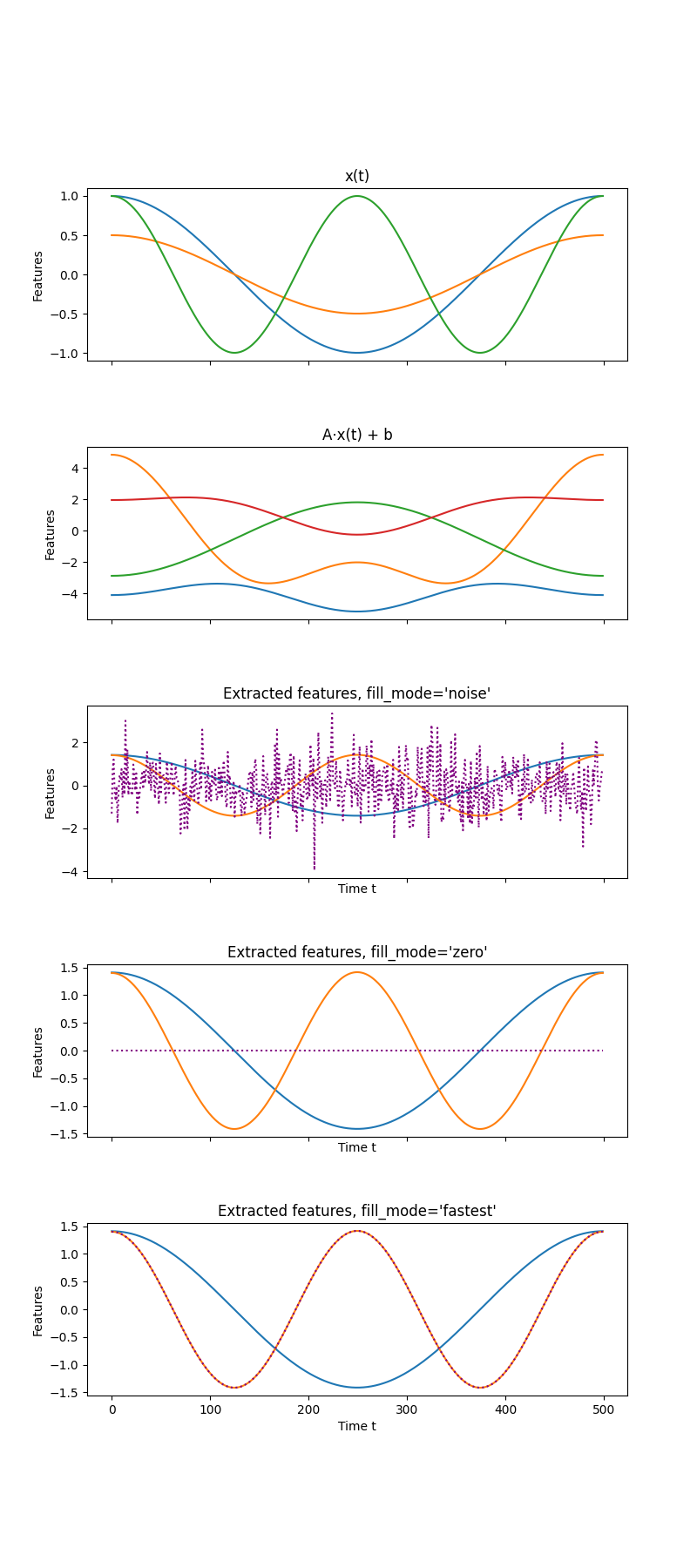
Out:
/home/docs/checkouts/readthedocs.org/user_builds/sklearn-sfa/envs/latest/lib/python3.7/site-packages/sksfa/_sfa.py:337: RuntimeWarning: During whitening, 2 trivial components with roughly zero explained variance have been found. This probably means that the effective dimension of your input is too low to find the desired {self.n_components_} slow features. Ways to deal with this are:
        Injecting noise via the 'noise_std' parameter.
        Providing more data.
        Lowering the 'n_components' parameter.
        Lowering the threshold 'robustness_cutoff'.
Since 'fill_mode' is set to noise, missing output features will be filled by independent white-noise.
  warnings.warn(warning_string, RuntimeWarning)
/home/docs/checkouts/readthedocs.org/user_builds/sklearn-sfa/envs/latest/lib/python3.7/site-packages/sksfa/_sfa.py:337: RuntimeWarning: During whitening, 2 trivial components with roughly zero explained variance have been found. This probably means that the effective dimension of your input is too low to find the desired {self.n_components_} slow features. Ways to deal with this are:
        Injecting noise via the 'noise_std' parameter.
        Providing more data.
        Lowering the 'n_components' parameter.
        Lowering the threshold 'robustness_cutoff'.
Since 'fill_mode' is set to zero, missing output features will be filled by a 0 signal.
  warnings.warn(warning_string, RuntimeWarning)
/home/docs/checkouts/readthedocs.org/user_builds/sklearn-sfa/envs/latest/lib/python3.7/site-packages/sksfa/_sfa.py:337: RuntimeWarning: During whitening, 2 trivial components with roughly zero explained variance have been found. This probably means that the effective dimension of your input is too low to find the desired {self.n_components_} slow features. Ways to deal with this are:
        Injecting noise via the 'noise_std' parameter.
        Providing more data.
        Lowering the 'n_components' parameter.
        Lowering the threshold 'robustness_cutoff'.
Since 'fill_mode' is set to fastest, missing output features will be filled by duplicates of the fastest signal.
  warnings.warn(warning_string, RuntimeWarning)
import numpy as np
from sksfa import SFA
import matplotlib.pyplot as plt


n_samples = 500
n_slow_features = 3
dim = 4
fill_modes = ["noise", "zero", "fastest"]

# Generate different randomly shifted time-scales
t = np.linspace(0, 2*np.pi, n_samples).reshape(n_samples, 1)

# Generate latent cosine signals
x = np.hstack([np.cos(t), 0.5 * np.cos(t), np.cos(2 * t), 1.5 * np.cos(t)])

# Compute random affine mapping of cosines (observed)
A = np.random.normal(0, 1, (dim, dim))
b = np.random.normal(0, 2, (1, dim))
data = np.dot(x, A) + b

# Extract slow features from observed data

# Plot cosines, mapped data, and extracted features
fig, ax = plt.subplots(2 + len(fill_modes), 1, sharex=True)
fig.set_size_inches(8, 18)
fig.subplots_adjust(hspace=0.5)
for d in range(n_slow_features):
    ax[0].plot(x[:, d])
ax[1].plot(data)
for idx, fill_mode in enumerate(fill_modes):
    sfa = SFA(n_slow_features, fill_mode=fill_mode)
    slow_features = sfa.fit_transform(data)
    ax[2 + idx].plot(slow_features[:, :-1])
    ax[2 + idx].plot(slow_features[:, -1], linestyle=":", color="purple")
    ax[2 + idx].set_title(f"Extracted features, fill_mode='{fill_mode}'")
    ax[2 + idx].set_xlabel("Time t")
ax[0].set_title("x(t)")
ax[1].set_title("A⋅x(t) + b")
for idx in range(2 + len(fill_modes)):
    ax[idx].set_ylabel("Features")
plt.show()
Total running time of the script: ( 0 minutes 0.446 seconds)